
Why Were Peptides Banned, Why Are They Back, and Are They Any Good?

Video
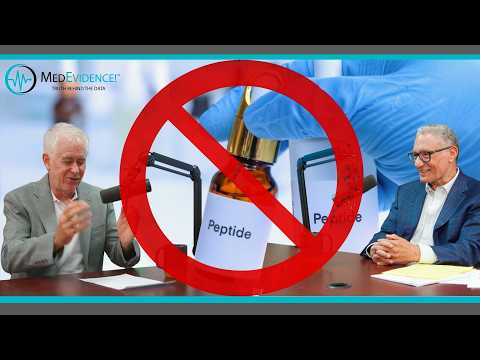
Why Were Peptides Banned, Why Are They Back, And Are They Any Good?
Audio
|
|

Transcripts
Announcer 0:00
Welcome to MedEvidence, where we help you navigate the truth behind medical research with unbiased, evidence-proven facts, hosted by cardiologist and top medical researcher, Dr. Michael Koren.
Dr. Michael Koren 0:11
Hello, I'm Dr. Michael Koren, the executive editor for MedEvidence! And every once in a while, we have an opportunity to get on a bandwagon to talk about a trend and then address that. And I'm very privileged today to have Dr. Mitchell Rothstein with me. And Mitch and I are going to discuss this latest trend of peptides. Dr. Rothstein is a very experienced and knowledgeable clinical investigator, triple board certified in critical care medicine, sleep medicine, and pulmonary medicine. I think I got that right. Right. And really just a great student of medical history. So Dr. Rothstein and I are going to have a discussion about this peptide craze. What the heck is it? Should you jump on this bandwagon or should you get off this bandwagon as quickly as possible? So, Mitch, welcome again to MedEvidence! Thank you.
Dr. Mitchell Rothstein 1:04
It's a pleasure to be here as always.
What A Peptide Really Is
Dr. Michael Koren 1:06
So let's start by just defining what the heck is a peptide. Is that something new that just came up in the last five or ten years with the GLP1s? Or does it mean something else?
Dr. Mitchell Rothstein 1:19
Well, the peptides in themselves are a group of molecules, and peptide is really a description of a molecule that is composed of a chain of amino acids. And generally, we call a chain of amino acids that's 50 or less amino acids in a row, a peptide, and anything bigger than that a protein. And the thing that kind of happens between the peptide and the protein division is that once you have a longer chain of amino acids, they have a conformational change and becomes more of a complex molecule and somewhat more receptor-driven, receptor sensitive. But in general, we know that, for instance, right now, we've so far discovered about 7,000 peptides in the human body that are internally generated. We know that right now in development, there are about a hundred peptides that are being actively investigated, and there's about 150 in the pipeline, and there's probably six or seven hundred more that are being looked at by pharmaceutical companies for potential entry into the peptide into the pipeline.
Dr. Michael Koren 2:28
So that's interesting. And again, just breaking it down for people that may remember this from high school or college biology or uh first-year medical school, that peptides are amino acids, which are the building blocks of proteins. If uh if my memory serves me, there are 20 amino acids out there. I think that's right. And some of them are essential, meaning that we have to get them for other sources, other is that we can make ourselves in our bodies. Don't ask me to recite that list. I probably could have done it during biochemistry days, but not right now. But those are the building blocks. Those are the building blocks. And and between two and fifty amino acids in a chain or some sort of collection is a peptide. Correct. And then you just said beyond 50, it's a full-fledged protein.
Dr. Mitchell Rothstein 3:14
And that that's the way the nomenclature is. And to get to those amino acids, they're coded from DNA, usually requiring three nucleotides kind of in a row to code for one amino acid. So we can actually look at DNA and see on the DNA strand where that particular peptide or protein comes from.
Dr. Michael Koren 3:36
And then you mentioned that our bodies already have thousands of peptides. So this is not new. This is not a new trend. This is how our bodies have worked since the beginning of time. And why all of a sudden is this focus on peptides? Why are people talking about this as the cure all? So explain that a little bit to me in terms of the recent history.
Dr. Mitchell Rothstein 3:55
Well,
Why Peptides Blew Up Online
Dr. Mitchell Rothstein 3:56
in it it's fascinating because actually the timeliness of this discussion is uh very important. And it I think there was a kind of collision of things that happened. Number one, during COVID with isolation, we had restrictions and people turn to social media like they never have before, and we're getting information from various influencers and "experts" in different fields. And at the same time, uh right on the tail end of that, you had a peptide, GLP1s, that were unbelievably powerful, effective, and studied over and over again and developed, had were found to have properties that expanded their original direction. So for the GLP1s, when GLP1s first came out, they weren't marketed as cures for obesity, diabetes, sleep apnea, cardiovascular disease, kidney disease. They got one indication, were studied to the nth degree. We knew all about drug levels, toxicities, the pharmacokinetics, and then during those investigations, they earned through the development of data other indications. And we see with these peptides, they're actually being promoted for other indications without any evidence. So people are just making claims that, well, we think that these molecules do this, and there's an element of truth in what's being presented to the public. And but all that data is really on animal data. It's not really on human data, and they're expanding the use of these peptides to things that have never been studied in humans.
Insulin And The Injection Problem
Dr. Michael Koren 5:36
So let's break this down a little bit more for the audience in terms of the history of quote peptides as therapeutics. So I guess the big first grade peptide therapeutic was insulin.
Dr. Mitchell Rothstein 5:49
Right.
Dr. Michael Koren 5:50
And that came out a little over 100 years ago, developed in Canada by Banting and Best, if memory serves me correctly. And this was a concept of helping people that could not produce insulin at all and taking something that came from an animal, purifying it, and then injecting that peptide. And the injection is an important part of it, based on my medical school recollection, because peptides as groups of amino acids get broken down in your stomach and your intestinal tract. So you can't really take peptides as therapeutics by mouth, at least historically.
Dr. Mitchell Rothstein 6:26
Right.
Dr. Michael Koren 6:27
And so people used insulin, it was life-saving. Of course, not all diabetics are low in insulin. In fact, most diabetics nowadays have high levels of insulin, but that's a whole other story. But what has happened, I think, over the last 30 years is that there was a tendency to shy away from developing injections for treatment and more towards oral medication by mouth. And I think what the GLP1s did, and correct me if I'm wrong, is got people thinking again about the efficacy of injecting something to help them, in this case, of course, with weight loss and diabetes and other things. And that has now opened the door for injectable drugs.
Dr. Mitchell Rothstein 7:11
Well, I think that's absolutely true. And I think the tail end of that, now we're seeing that with some of these GLP drugs, there now there's oral forms becoming available, kind of backing off that. But in the peptide market, where you don't really have any data to support it, the kind of the story of the peptide, uh the the fact that you have to inject the molecule kind of adds to its accolades that, oh, it it and its power, that this is really going to work for me. It's really something scientific. I'm doing something along those lines.
BPC-157 And The Miracle Claims
Dr. Mitchell Rothstein 7:42
In fact, the golden-haired child in the peptide world right now, the most commonly one ordered through the gray market process, is something called BPC157. And BPC157 stands for body protective compound. And it is a 15-long amino acid chain from an original parent compound that was distilled from human gastric juice by a Croatian medical student over 30 years ago. So just to give you some idea where the science in this is, that the the guy that distilled it has never ever published the original parent compound. And like we were talking before, you you can find like the DNA origins of most of these peptide strands. They've never been able to find anything on the human genome that's compatible with BPC, which is just a 15-chain amino acid from the parent compound. And the discoverer said that when asked about that, why he hasn't released it, he said once you have a child, you always want to keep that child only yours. That was the medical reasoning behind it. And despite there being no mechanism of action, no receptor for the compound, it is the most commonly ordered compound, and it's touted from everything from improving ligaments, improving wound healing, recovery. There is neurogen- there's neuropeptide changes with it that are established with it as well. There has never been a randomized controlled study with the drug. And when you buy these drugs on the gray market, you get them from China. That's where they come from. And an analysis of all these products coming through the gray market shows that at least 30% of them don't even have the compounds that they're advertised for on them. And people still inject them.
How The Gray Market Works
Dr. Michael Koren 9:38
Unbelievable. So let's break down this gray market concept for people who are viewering or listening to us. Gray market meaning it's not through the standard channels in which we usually get our medication. So explain that a little a little bit more and why people have these peptides they can inject. Like how does it even work? Why, why, why are they available?
Dr. Mitchell Rothstein 10:02
Well, that's a great question. And and I'm hoping you'll help me with some of the uh regulatory hurdles with this because frankly, it was a little too much for me to consume all at one setting as well. So these are of these were available. There were 20 peptides uh in 19- in 2023 that were available through compounding pharmacies. They had a compounding pharmacy advisory committee meeting at that time, which included 14 members, uh, all FDA scientists that looked at all the data on these peptides and they say, you know what? There's no information on this. This is all animal data, there's no human trials, and we as a compounding pharmacy, we don't have to follow up with adverse effects. We have no idea what this is doing, and they banish.
Dr. Michael Koren 10:53
But generally, if there is something that will be touted to have a therapeutic effect, there's certain rules and regulations that happen. And nutraceuticals sort of get away from this because they say we don't cure or treat or do anything, but you can still take it to jump higher or have a better sex life, right? Right. So, so is that the mechanism that was used here that these are again now things that people are injecting that are food products of some sort or come from an animal source that's not, quote, routinely manufactured, and that's how they get away with it, or just explain that a little bit more.
Dr. Mitchell Rothstein 11:28
Well, uh that that's the part that I'm actually a little bit gray marking on as well, because these are not, these are largely all synthetically produced. And they can be produced in many different forms as salts, as esters, and there's no control over it. In fact, as part of the rules of this batch drug compounding under this 503A rule for compounding pharmacies, this is under state regulation. And basically, if you make it to this 503A rulebook, you don't have to label the drug, you don't have to put a dosage on the drug that's completely up to the quote prescribing physician, and there doesn't have to be any real medical indication for the drug other than you know improving well-being, overall enhancement of immunity, wound healing, those kind of very vague generalized effects. At least that's my understanding. Is that your understanding of it?
Dr. Michael Koren 12:29
Well, I understand that nutraceuticals have a different pathway because they're not therapeutics. And so the only thing that could explain this from a regulatory standpoint is that these are not considered therapeutics in the way we develop medical products historically. But there are laws that we're very well aware of that if it is being touted as something that treats people, then you have to file an IND. You have to go through a process that will at least show that safety has been established. And then nowadays, more and more, for you to market something, you have to do safety and efficacy in a large patient population to really understand what the trade-offs are between side effects and the benefits of a of any product. And that scrutiny is got was not at the same level for devices as it was for drugs, but the scrutiny for devices historically has gotten more and more intense. So, again, this is this little loophole that may have worked if you say, okay, well, we want you to drink this milk because we think it's good for your digestive tract. That's what my my nanny told me when I was a kid. Well, okay, great. So you try your goat's milk or your combination of calf milk, goat milk, or goat milk, or whatever, whatever it may be, and because it's not necessarily treating something, get away with it. But now that you're taking hamburger meat, chopping it up, digesting it, and then injecting it, well, that's a little bit different, in my opinion.
Dr. Mitchell Rothstein 14:07
Yeah, well,
Compounding Rules And Politics
Dr. Mitchell Rothstein 14:08
well, and you know, this is kind of the entry of politics into this peptide story. So in 2023, they banned these 20 uh peptides that compounding pharmacies were allowed to produce. And then during that committee has 14 members, and they were all FDA scientists at that point. Well, over the course of three, four years, eight of them dropped off from the committee, retired, withdrew. So our current uh HHS secretary brought this idea back up that he's in favor of peptides, so maybe we ought to look at these peptides again. So we appointed eight new members to the board, most of which have uh some conflict of interest with the compounding pharmacy industry. And they took, of the 20, they took seven of these molecules back and they said, well, maybe we can advise the FDA to put these back on the things that were allowed to compound. And so these seven peptides were brought back just last month, and the panel voted on them, and they approved six of the seven, and the votes on the six of the seven were, as you could predict, eight were in favor and six were against for all the six that were approved. So there's some political engineering to having these now considered to become FDA approved to allow the compounding pharmacies to produce again. And the theory behind this is that the horse is already out of the barn. There are so many people that are getting these products on the gray market, even if they don't work. At least this way we can, you know, supervise purity and batch-to-batch consistency and make sure that they're not compromised in any way. And it's kind of uh antithetical to normal drug development and distribution that already, I guess the marketplace decided that they want them, and now we have to make sure that they're safe for everybody or safer, not necessarily effective, but just safer to inject in your body.
Dr. Michael Koren 16:15
Sure. So you brought up a number of issues. The first is what you're getting. Is it pure? Is it really what is being stated? When we work with pharmaceutical companies and others that are part of the regulator industry, there are inspectors that go in, there are people that test these things to make sure what you're actually getting is what we are saying you're getting, things of that nature. So this industry, i.e., this compounding pharmacy, doesn't have that scrutiny, as I understand it.
Dr. Mitchell Rothstein 16:43
Correct. They have well, they have oversight and there are standards. But the molecule-
Dr. Michael Koren 16:49
But you are inspectors going in to see if what they're producing is exactly what they say they're producing.
Dr. Mitchell Rothstein 16:54
They're being tested intermittently. They are here in the United States at most of these compounding pharmacies to greater or lesser extents. None of that's going on in the gray market at all. So that's one of the arguments that, well, people are taking this stuff, so let's at least make it as safe as it can be, even though we don't know if it works or not, rather than let them be at the you know, the mercy of the gray market from China.
Why The Molecule Is Not The Drug
Dr. Mitchell Rothstein 17:17
And I think one of the things that you brought up, which I didn't really recognize that well until I got my deep dive into YouTube, was that a molecule is the molecule is not the drug. So what when Lily or whoever produces a statin, as you said, in a standardized laboratory, it's scaled up, it's industrial produced, that particular mole molecule of whatever statin that is, if that's compounded in a U.S. pharmacy, it doesn't mean that that molecule in the U.S. pharmacy is going to work because it's not made under the same conditions it was at the big pharma laboratory. So those things don't translate automatically. The the molecule doesn't transfer its functionality if it's made under different conditions.
Dr. Michael Koren 18:07
Simple things like stereoisomers, for example, they are chemically the same, but their structure is mirror image of each other. And one works and one might not work. So that would be a good example of that.
Dr. Mitchell Rothstein 18:19
Yeah, absolutely.
Dr. Michael Koren 18:20
So getting back to some of the issues with the quote gray market, there is some analysis to make sure that at least chemically what you say is being produced can be tested. But it sounds like it may be a little bit hit or miss compared to the regulated industry.
Dr. Mitchell Rothstein 18:38
Well, the gray market is completely if you want to know what's in your product that you got, your Cmax that you got from China, you have to take it to a third-party testing facility. That's the only way you know. Okay. And so you can test it yourself. But if one batch of Cmax comes back and it's, oh yeah, that's a 100% Cmax, that doesn't mean your next order is going to be 100% Cmax or have any Cmax in it at all.
Dr. Michael Koren 19:03
Okay. So that's one element. And then the the
Dr. Mitchell Rothstein 19:06
Oh, and by the way, uh just I'm sorry to interrupt.
Dr. Michael Koren 19:08
Sure.
Dr. Mitchell Rothstein 19:08
But when you get this bottle on the gray market, it says on the bottle, not for human use for research purposes only.
Dr. Michael Koren 19:17
Okay. So that that's a loophole. Yeah.
Dr. Mitchell Rothstein 19:19
Well, it's a loophole. But the guy, uh whoever's injecting that is, I'm sure, sees that and then still puts the needle in and still puts the needle in.
Dr. Michael Koren 19:28
Right. But and but uh that's getting back to our discussion about there's loopholes, and they get away with it because they're not actually treating anybody.
Dr. Mitchell Rothstein 19:35
Right.
Dr. Michael Koren 19:35
They're making believe they're not treating anybody.
Dr. Mitchell Rothstein 19:37
Right.
Dr. Michael Koren 19:38
So the next step, of course, is whether or not the actual molecule has the effect that's being marketed. And we know from our work that that takes hundreds or thousands of patients and lots of operation, uh lots of observation, lots of hard work to determine that outcome, whether or not it helps you lose weight or you actually heal faster if you fracture yourself. Literally, this is the careful science that we do day to day. And that is not being done in these gray market situations.
Dr. Mitchell Rothstein 20:10
Well, not only in the gray market, even in the pre-clinical market. I mean, there's these compounds like BPC have been around for 30 years. In 30 years, there was one human trial using BPC as so BPC, just for a little background, that stands for body protective compound. It was uh isolated from human gastric juice, though nobody can figure out what part of human gastric juice it did. And the theory was that, well, since the stomach's full of acid and it doesn't dissolve, there must be something in there that protects it, and then they have all these other properties that now BPC is working for. The only human trial that anybody could find was 20 patients with inflammatory bowel disease that used BPC as an enema. And on a telephone follow-up, nobody really noticed any difference in the way they felt two weeks later. But beyond that, all the data is preclinical.
Dr. Michael Koren 21:06
Okay.
Dr. Mitchell Rothstein 21:06
And when they're presented.-
Dr. Michael Koren 21:20
So just for people listening to us, what that means is that no one looked to see if they developed cancer down the Road. No one looked to see if they had bad infections, or if they were hospitalized, or they dropped dead suddenly. All these things are just not known for these particular products.
Dr. Mitchell Rothstein 21:24
For any of these products. And additionally, for the compounding pharmacies, part of the rules are under this 503A that you don't follow up patients for adverse events. So there's no way of tracking that in the future either. If it, if it's, if these products go through, get approval from the FDA to go back through the compounding pharmacies here.
Dr. Michael Koren 21:47
And that just from a pure safety standpoint to see what happens after the injection. Of course, when you do things in a placebo controlled environment, then you can make much more precise observations both on whether or not It works and what the safety is versus just the things that people get over the course of time.
Dr. Mitchell Rothstein 22:06
Right. Absolutely. And one of the points that was made was you know, the idea of having a placebo-controlled trial is that we know that placebos during trials there's positive effects. People in the semaglutide uh step one trials lost weight on the placebo. They didn't lose as much as they did with the drug. And that difference between how much weight they lost on the placebo and how much weight they lost on the drug was the drug effect. You know, but there was an effect from the placebo. And when you inject stuff, I imagine there's some placebo response to that as well.
Dr. Michael Koren 22:40
There you go. So maybe just injecting saline is just as good as these peptides.
Dr. Mitchell Rothstein 22:44
As far as we know right now, I think that's a fair statement. And I think one of the um overriding aspects of this is that, at least from my uh exposure to the peptide world now, is that since we don't have a lot of human data, really any human data at all, the either it hasn't been done or it hasn't been published. One of those two things. Or if it hasn't been done, you know, why hasn't it been done? And usually all these drugs were in pipeline development from one of the pharmaceutical companies. And as you had pointed out, for either safety reasons or efficacy reasons, or there was a better competitor out there, or there wasn't a marketplace for it, they abandoned it and it went into this salvage graveyard, which now in the last decade has been revived as all these products having biological activity. And some of them might, but we don't have any data to support any of that. And we have no safety data, no pharmacokinetic data, we have no idea about contraindications, we we just don't have any of that information. All that information is provided by the studies we do here, you know, regardless of how you feel about the FDA, that whole process of drug development defines all those issues and let's uh and let's say, you know, here's the benefit, and we can reduce we know what the risks are, we know what the patient population is, those things are all defined so we can safely, you know, provide benefit to patients.
Retatrutide Copycats Before Approval
Dr. Michael Koren 24:17
Interesting. So let me bring up an example that I read about recently that kind of gets into this really blurry area of peptides and what is approved and what's not approved, and whether or not people can kind of get a head start on the market versus what people have to go through if you follow formal FDA processes. And it's it's a drug that has been out there called retatrutide. And this is a quote triple agonist incretin, meaning that it has the effects of the GLP1 and GIP, and the third one is...
Dr. Mitchell Rothstein 25:00
Glucagon.
Dr. Michael Koren 25:00
Glucagon, thank you. And so it has all these effects which help people lose weight and improves their metabolism. And it's a drug that's been developed in a formal way by Eli Lilly. But the copycats are already on the market before the drug is even approved. So, how does that happen and how is this going to work out? And is that people being smart and getting ahead of the curve? Let me throw that out there.
Dr. Mitchell Rothstein 25:26
Well, I don't know if they're being smart and getting ahead of the curve. I'll save that judgmental statement for later. But yeah, it it gets out there through these compounding pharmacies and through the gray market. So the the molecular structure is known, it's patented, but people can develop salts, esters, you know, other forms of that same molecular structure. That doesn't mean it's the same drug, like we were talking about before through manufacturing requirements and all those other things. But I think that's one of the lines that people want is they want to have something before it's available for everybody else. It'll get them a head start. The information that we know on GLP1s and GLP GIPs are all very positive from cardiovascular effects, from lean body mass, from weight, from all those things. And since there's no obvious downside, in fact, the people that are using it are using it below most of them aren't even overweight. They're not using it for weight loss. They're using it for general health to reduce cardiovascular risk, improve their renal function, and overall stimulate their immunity. And they use it at a dose that's not been studied or recommended, but they figured that, well, if they're recommending nine milligrams a week, I'll just take one milligram a week, and that ought to give me something, an edge on everybody else. So I think it's, you know, a lot of this, like everything else that w we've seen during our lifetimes, we were talking about Laetrile, for example. Back, you know, 20 years ago, we had people spending hundreds of thousands of dollars, hundreds of thousands of people going to Mexico to cure their cancer because they were hopeful because there was no other option. And, you know, that kind of intersection between hope and science kind of gets overwhelmed by the stories, the mythologies, you know, all the positive evidence that's out there. Because people, you know, if you inject BPC or you inject one of these other drugs and nothing happens, you don't report that. You just walk away. Nobody's posting about it. So it's a it's a marketing bonanza for people.
Dr. Michael Koren 27:35
Right. So maybe people that had a good outcome, whether or not it was related to the product, will speak about it, but people that have a bad outcome will get lost in in the noise in the internet.
Dr. Mitchell Rothstein 27:46
Well, and part of that noise, too, is for the people that speak about it, is you don't know what else they're doing. You know, a lot of these people that are reporting these great effects with one of these other peptides are also taking, you know, testosterone. They're taking uh mil anti-inflammatory drugs, they're taking, you know, they're doing physical therapy, they changed their diet, they did other things at the same time, and none of that is controlled for in this marketplace.
Dr. Michael Koren 28:12
The the other thing that I read about Retatrutide is that Eli Lilly, that owns the patent, can't actually take protective actions until it's on the market.
Dr. Mitchell Rothstein 28:21
Right.
Dr. Michael Koren 28:21
So that's a situation.
Dr. Mitchell Rothstein 28:23
Yeah, yeah. This is all this this regulatory legal aspect of the peptide world is a little bit confusing and and complicated. And the fact that uh people can patent a certain molecule in a certain form, but just by altering that a little bit, you know, or adding something to it, like riboflavin, all of a sudden you have a molecule that escapes those patent laws. And if you think about it, you know, the one thing the the pharmacies don't want to avoid is making money. So you want your patent to stay because it cost you a billion dollars to make the molecule and bring it to the marketplace. You have to recoup that or else you get out of business. And going back to all these unregulated gray market peptides, if any of them actually worked, wouldn't the companies be racing to produce them just like they're racing to produce the GLP1s, the GLP2s, the GLP3s? I mean, we don't see that in the marketplace. And that I think tells a lot about these molecules themselves.
A Five Step Safety Framework
Dr. Michael Koren 29:26
So let's finish up our discussion with just a take-home message for people who are either listening or are viewing this. And my question to you is that are there any circumstances where you would take a peptide? And are there any circumstances where you would take a gray market peptide? As a practicing physician, for example, we do have situations where we think that peptide type product would be beneficial for our patients, but they can't afford it. And so the compound pharmacies have served this role in part for the incretins. And I don't know if they're going to serve this role in other places, but just give people some take-home advice about, in your opinion, what would you recommend? What would you consider, and what would you absolutely not consider?
Dr. Mitchell Rothstein 30:12
Well, I I think rather than my opinion, there's been a published kind of five-step framework to analyze peptides as whether or not you should consider them for yourselves. And the first step is is there a defined mechanism of action? Do you know what the downstream effects from that mechanism of acting action is? And are the outcomes from that mechanism of action plausible? Is it is it a reasonable thing? The second step is has there's been shown proven human benefit from the compound? The third step is do we understand the pharmacokinetics and the downsides? Do we know what concentration it is, what dose it is, what the route of administration is, has that all been well defined? The next step is that benefit-risk analysis, and that's different for everybody. I mean, if there's no other option around and you know with certainty what the outcome benefit of the drug is, then it might be worth considering it, having passed all those other steps. And then the final step is is there an alternative treatment that can get you to the same place? Maybe it's not as sexy, maybe you don't have to inject it, maybe you have to go to physical therapy three times a week. But is there an alternative that's been better described, that we know the safety issues on, that is affordable to you? So for me, since all the compounds that are being currently listed for FDA reassessment don't have any human data whatsoever, I would say no, especially because the bottle says not for human consumption for research purposes only. So I wouldn't recommend it.
Dr. Michael Koren 31:59
So I think that's very cogent information that if a bottle says not for human purposes and you're a human, don't take it.
Dr. Mitchell Rothstein 32:07
I I think that's the take-home message.
Dr. Michael Koren 32:09
That's terrific. Mitch, as usual, very insightful. Thank you for all the great research you did. Thank for for educating our audience, and thank you for being a guest again on MedEvidence.
Dr. Mitchell Rothstein 32:22
Thanks. Always
Where To Learn More
Dr. Mitchell Rothstein 32:23
a pleasure.
Announcer 32:23
Thanks for joining the MedEvidence Podcast. To learn more, head over to Medevidence.com or subscribe to our podcast on your favorite podcast platform.

