
PCOS to PMOS, Changes in Name and Treatment Options

Video
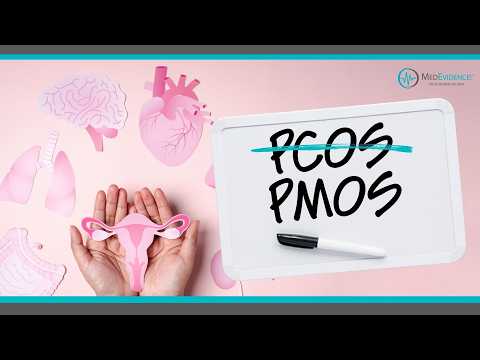
PCOS to PMOS, Changes in Name and Treatment Options
Audio
|
|

Transcripts
Transcrip generated by AI
Announcer 0:00
Welcome to MedEvidence, where we help you navigate the truth behind medical research with unbiased, evidence-proven facts, hosted by cardiologist and top medical researcher, Dr. Michael Koren.
Dr. Erich Schramm 0:11
Hello, and welcome back to another episode of the MedEvidence Podcast. I'm your host, Dr. Erich Schramm. I'm a board-certified family physician, longtime clinical research investigator with the ENCORE Clinical Research Group. And I'm very excited to be talking to Dr. Richard Myers today. Dr. Myers is a board-certified OBGYN and fellow long-term clinical research investigator. Welcome to the Med Evidence Podcast, Richard.
Dr. Richard Myers 0:36
Thank you. Glad to be here.
Dr. Erich Schramm 0:37
Well, great. You know, we have a really interesting topic today: polyendocrine metabolic ovarian syndrome, PMOS.
Dr. Myers’ Path Into Research
Dr. Erich Schramm 0:44
But before we do the deep dive, can you tell me a little bit about your background, your education? What got you interested in obstetrics, gynecology, and research?
Dr. Richard Myers 0:54
Sure. Well, I grew up in Savannah, Georgia, and then I went to Wofford College, followed by Medical College of Georgia and Augusta. And then I did my residency training at the UF uh in Jacksonville. And after that, I spent a couple of years with Uncle Sam in the military as an OBGYN and was fortunate enough to be stationed here at the NAS JAX and was involved in teaching there because of the Family Practice Residency Program. And then I went into private practice in 1978. The reason I chose OBGYN is it's a cross between surgery and medicine and the longevity of caring for patients over many, many years and developing relationships, which is what I wanted since I'm a people person.
Dr. Erich Schramm 1:37
Right.
Dr. Richard Myers 1:38
And I got involved in clinical research because Dr. Koren, in the uh, who founded ENCORE Research, asked me in the mid-90s, probably around 1995, 1996, if I would be interested in doing some women's health studies embedded into my practice, and thought that would be an additional benefit for not only my patients, but for myself to continue to learn. And so that's how I got started. And it's just evolved over the last quarter of a century to where I am now.
Dr. Erich Schramm 2:09
Great. That's really fascinating. So some of the early studies, uh what what were you looking at? And what kind of studies were those?
Dr. Richard Myers 2:16
In the early years, it was mostly birth control pills and the menopausal hormone replacement treatments, and then doing some sub-investigator work on lipid studies.
Dr. Erich Schramm 2:27
Right. And I think that was, you know, and you and I have known each other for a long time. And, you know, I think that's really impressive that somebody as an OBGYN, how much you've kind of your your growth and expanding and then looking at cardiovascular health. You know, I know you're currently you're you're an investigator on a vaccine study. And so you've really kind of branched out and you know, you're a very knowledgeable investigator, not just not just in the OBGY N space. I really uh commend you on that. And so in also a sense that you've kind of have this lifelong sense for wanting to of learning and teaching as well.
Dr. Richard Myers 3:04
Yeah, I I think you know it broadens one's perspective. And it's also pretty cool to look back at some of the medications we've studied that have come to market and how they've been beneficial in healthcare, not only for women, but for the broader population
Women’s Health Trials That Changed Care
Dr. Richard Myers 3:22
in general. I think one of the most intriguing things to me is everybody thinks that uh all the studies you do about medications, but one of the most interesting studies we did, we were part of was the development of HPV testing for cancer screening for females. And that now has become the standard of care, not totally replacing the pap smear, but it allowed less frequent intervals of screening for cervical cancer by doing that. And we were part of that national study, and that that's was very rewarding to see that that's used every day now.
Dr. Erich Schramm 3:56
Right. Pivotal, right? Because you're right, before that it was, you know, women had to undergo frequent, you know, pelvic and bimanual exams. Exactly. And now we we can using non inv more non-invasive tests and get a lot better results. So again, that's another example of what's what things that develop in clinical research and impact on practice.
PCOS Becomes PMOS And Why
Dr. Erich Schramm 4:19
So polyendocrine, metabolic ovarian syndrome, PMOS, I learned it as PCOS, polycystic ovarian syndrome. So why the name change?
Dr. Richard Myers 4:31
Well, there's an interesting history behind polycystic ovarian disease. It when I was in early training, it was called Stein-Leventhal syndrome because two physicians back in the 1930s described this triad of symptoms that created the picture of this syndrome. There were patients who had excess male hormone, and that was manifested a lot of times with excessive hair growth and some skin changes. They would have infrequent periods, sometimes as little as one or two a year. And then on ultrasound, they saw ovaries that were enlarged and had a lot of small, quote, cyst, end quote, which were really just immature follicles. And that was what was described as polycystic ovarian syndrome. But it was a very confusing and misleading term as we have learned over the years that it was it's much more than an ovarian problem. So there was a consensus group of people, including Academicians, you know, patient uh advocate organizations, and about a month ago, they recommended a name change to polyendocrine metabolic ovarian syndrome, with the idea being it would be less confusion, not only to patients, but to physicians, and that hopefully people would be better educated and be better treated. But the truth of the matter is we don't know yet. And it is going to be a transition for about three years. I think they sort of said, let's look at how this works over the next three years and see if if if we can mesh the ovarian and metabolic changes that go with the syndrome and so that patients will get better diagnosis and better treatment, and not just address the ovarian issues, but the metabolic issues.
Dr. Erich Schramm 6:32
Right. And you touch on polyendocrine. So maybe uh talk a little bit about that if you could.
Metabolic Risks Beyond Fertility
Dr. Richard Myers 6:39
Well, I think for many, many years the focus was always on irregular periods and infertility. And there's still a focus on that. But many of the and the patients present differently. They're not all the same phenotype or physical appearance. They're not all obese. They don't all all have very obvious excessive hair growth. So there's a a spectrum of how the patients present. But a lot of them have metabolic problems. They have insulin resistance due to their obesity, they have lipid problems, they can develop cardiovascular problems, they can develop visceral or internal fat in organs like the liver. And none of this is healthy. So the idea behind this change in name is hopefully a better approach to management, depending on, again, what the goals of the individual patient is and what they need mostly.
Dr. Erich Schramm 7:33
Right. And so kind of uh kind of at what age do you generally see this kind of evolving, or should you this be on the radar for physicians to be looking at certain age range of patients to look for these problems?
Dr. Richard Myers 7:48
Well, you're probably not going to pick it up until they reach adolescence. And then somewhere in the neighborhood of 12% of adolescents to adults will present with this constellation of symptoms that form the syndrome. So hopefully family doctors, gynecologists, endocrinologists, internists will all be more tuned to what to look for. But again, you're going to look for uh dermatological changes, cystic acne, hair growth, obesity, irregular periods associated in the gynecologist's office with the, you know, I can't get pregnant, I've been trying to get pregnant type thing. So presentations are gonna be different depending on who the patient sees, what age they're at, and what tends to bother them.
Dr. Erich Schramm 8:34
What about family history? Is that something that should be on the radar?
Dr. Richard Myers 8:38
There's probably a genetic component to this, but that hasn't been worked out very well. And so it's not something that's uh foremost in the eyes of history taking that you would look at that. A patient can present without any history of that in the family.
Dr. Erich Schramm 8:56
Okay. So so that isn't probably so much uh gonna be a strong guide for guidance on that. And you mentioned some that it's not just uh it's an ovarian issue, but increasing, you know, cardiovascular risk. And you know, you've been involved in cardiovascular studies, so I know you're very very familiar with that, and also having significant effects, cholesterol and other things that we know about insulin resistance and metabolism.
Dr. Richard Myers 9:23
Yeah. I I mean I think the biggest health-wise thing is the insulin resistance. We know that that's really not good for general health. So for the majority of these patients that are overweight, weight loss is going to help all of the metabolic issues, especially the insulin resistance. So in addressing that, we want to certainly look at lifestyle changes, including exercise programs, dietary programs, and there are some newer medications that have come out that are really beneficial in helping with not only weight loss, but helping with insulin resistance also.
Dr. Erich Schramm 10:01
Right. And touching base talking about insulin resistance, because in fact we know that you know a big driver in this disease state is having to do with the imbalances or the elevated levels of androgens and testosterones. And maybe you could talk a little bit about that and how that affects insulin resistance.
Dr. Richard Myers 10:23
It does adversely affect insulin sensitivity. So it makes it more difficult for uh the glucose to get into the cells to be used for energy if the testosterone levels are high. So the more we can do to increase the patient's ability, ability to utilize the glucose, the more healthy they will be in general. And so anything we can do to decrease the production of androgen will help the insulin resistance.
Dr. Erich Schramm 10:55
Right. And then we know there's out there some we can talk about treatments a little bit uh a little bit later here, but we know we've got some effective medicines to help treat in the the androgen blockers and things like that that can be very helpful for that.
Diagnosis Criteria And Ruling Out Causes
Dr. Erich Schramm 11:09
So in terms of making those diagnoses, um how do you arrive at that? What what's what kind of criteria are you using for that?
Dr. Richard Myers 11:17
The the criteria that's always been used is still being used despite the name change. So it's going to be someone that shows evidence either clinically or through blood work of excessive androgen, which is the male hormone. Irregular periods, generally periods that are greater than 35 days apart. And on ultrasound, they would have the typical ovarian presentation, although they don't have to. But if they have all the the enlarged ovary with multiple follicles on the periphery, any two of those three criteria is generally what you use in adults to make the diagnosis. For adolescents, it's it's actually the first two, just excessive androgen presentation and periods that are spread out and irregular.
Dr. Erich Schramm 12:03
Right. And talking about presentation, so uh and you and I, I'm a family physician, so I've seen a lot of these patients too. But to be clear, you know, hair growth, you know, inappropriate acne, skin changes and things. So, you know, this can become, you know, this can be really unsettling to patients, right? There's there's definitely an emotional component. And I know you've probably seen a number of those patients.
Treatment Based On Patient Goals
Dr. Richard Myers 12:27
Yeah, and and I think how you approach it depends on the age of the patient and the goals of the patient. So you take um, say, an adolescent that uh is more concerned about uh regular periods and her acne, you might use an oral contraceptive that has a progestin component that's anti-androgenic. You might use a medication called spironolactone, which has peripheral anti-androgenic effects. So that would be how maybe you approach an adolescent, an older woman who's married who wants to get pregnant, obviously you wouldn't put them on birth control pills, but you would probably start out using a medication to try to induce ovulation. That doesn't work. In the past, we've done actually surgical procedures such as wedge resections of the ovaries, or more recently, ovarian drilling because of laparoscopic surgery. And the whole point is you're trying to reduce ovarian mass, therefore reduce androgen production. And there are studies that show that that does increase the ability for ovulation in pregnancy. The downside is it's surgery, there are risks to that. You can get infections, you can get scarring that then may result in another problem for infertility.
Dr. Erich Schramm 13:48
Yeah and create another problem down the road, right.
Dr. Richard Myers 13:48
And then, you know, you get another patient who's I'm not interested in pregnancy, you know, I'm overweight, I've got some metabolic problems, you know, and you address those from the medical standpoint of trying to help them with their weight loss, their insulin resistance, their lipid problems. And so I think it really you have to individualize how you treat the patient with this syndrome.
Dr. Erich Schramm 14:11
Okay. Not a not a one-size-fits-all. You have to apply.
Dr. Richard Myers 14:14
Absolutely. And that's part of the confusing aspect of this syndrome is not only does treatment one size doesn't treat everybody, but the patients certainly don't present the same way. They present somewhat differently. And that's actually the truth that we have to be aware of in educating patients and physicians. Pay attention to your patient. They don't present in one way.
Dr. Erich Schramm 14:40
Right. And especially like you said at the beginning, because not every patient with uh PMOS is going to be an obese or overweight patient. Um
Dr. Richard Myers 14:49
that is correct.
Dr. Erich Schramm 14:49
Right. And so that that must make things more challenging. So do you look at getting or doing blood test or doing uh ultrasound to try to get a better idea about for those patients in terms of their diagnosis?
Dr. Richard Myers 15:04
Yeah, you do. You have to use um the tools that you have at hand, which are physical exam, blood work, sonograms. And you and if they have excess androgen, you've got to rule out other causes of excess androgen. And do they have an enzyme defect in the adrenal gland that may be taking the pathway of developing hormones down the chain that's going to produce more androgen? Or do they have maybe a pituitary tumor producing excessive stimulation of the adrenal gland? And then you get more androgen produced that way. So you have to rule out the other causes as part of the diagnosis of PCOS or PMOS.
Dr. Erich Schramm 15:46
You mentioned some treatments. Um I've utilized metformin a number of patients. And can you tell me a little bit about kind of how that works and why that might be another attractive option for patients?
Dr. Richard Myers 16:00
Yeah. Metformin is a medication that's used a lot in type 2 diabetes to increase insulin sensitivity. It's got some GI side effects. It's not in in PMOS or PCOS, it's not the first line drug that we would use. But it it's out there, but uh it's not not a first-line medication.
Dr. Erich Schramm 16:20
It was early, yeah,
GLP-1 Medications And A Real Result
Dr. Erich Schramm 16:22
early on because we had it. And now you're right. We've kind of evolved and maybe we could talk about kind of the latest class of medications, and you've had a lot of experience with the GLP-1s glucagon-like peptide ones, GIPs likewise, that a lot of people are familiar with because now they've been in initially they were in for diabetes, and we did those research studies, and then they moved into the weight loss base, and we did those studies as well. So we're really very familiar with it. But maybe you could talk a little bit about the impact and how it's affected PMOS.
Dr. Richard Myers 16:57
Well, first of all, our body naturally produces glucagon-like peptide and GIP, which is glucose insulin insulinotropic peptide, in response to food that goes into our gut. And so these medications, the GLP1 medications, mimic that. They're what we call agonists. And so when someone takes in diet, these medications would help them with gastric slowing. It would help produce more insulin so that the glucose goes out of the bloodstream into the tissue to be utilized. It also has a central nervous system effect where it decreases or increases the sense of fullness. And all of those things work to help the patient not eat as much and to lose weight over time. They need to be titrated up slowly over time because they can have some side effects of constipation and nausea, and uh about five percent of patients just can't tolerate them. Right. But overall, they're very, very good at helping patients lose probably on average, over time, 20 to 30 percent of their body weight.
Dr. Erich Schramm 18:11
And I understand uh we were talking earlier, and you really had a very compelling patient story that we were we were gonna bring up, and maybe you could share that with us.
Dr. Richard Myers 18:20
Sure. So I had this young nurse that worked for me, and she was a very and is a very pretty girl, but was always sort of thick, sort of chunky. And she was diagnosed with PCOS back in the day, and she worked hard trying to lose weight by changing her diet, and and that worked for a while. She lost, she was 5'8, weighed 240 pounds, and she lost about 40 pounds just with lifestyle changes, which is probably about 15 percent.
Dr. Erich Schramm 18:50
Which is impressive.
Dr. Richard Myers 18:50
Yeah
Dr. Erich Schramm 18:51
kudos to her. And we should emphasize lifestyle changes of to all our patients.
Dr. Richard Myers 18:55
And she did that with exercise and diet, to the point that her diet was, you know, she was measuring her calories, measuring her grams of food. Right. And but then she gained it all back and she got frustrated, and then she finally did a lot of research on her own and she restarted her exercise, restarted her lifestyle change, and then she went on a GP GLP1 and now has lost 78 pounds, which is about 30% of her body weight. And she's 5'8, 162 pounds now, happy as a lark, feels good, and uh she's uh probably, I think, in her early 40s at this point. And she's um she's just a good example of what can be done with hard work and these newer medications.
Dr. Erich Schramm 19:39
Right. And so, and hopefully that improved her metabolic profiles, reduced her long-term cardiovascular risk.
Dr. Richard Myers 19:48
It it it absolutely did. She actually she doesn't live in Jacksonville anymore, but she sent me her blood work pre and post, and it was remarkable the changes in the lipid and the glucose. And yeah, it it you know, you not only have her clinical change and her body appearance, but you have her laboratory change, which you know improves her cardiovascular health and metabolic health.
Fatty Liver Risk And Final Takeaways
Dr. Erich Schramm 20:12
Right. And you know, we uh we in research also do a lot of we see a lot of patients in dealing with fatty liver disease. And we're this is not a fatty liver uh disease discussion, and we've done a lot of MedEvidence topics podcasts with on that. But, you know, and thinking in terms of in your metabolic health, also we should be talking about, you know, our our liver health too.
Dr. Richard Myers 20:35
Yeah. And and and again, clinically we just look at central obesity. But if somebody's got central obesity, they probably have visceral or body obesity internally where you can't see it. We have fibro scans now that we can measure that and get some idea of that because we don't want the fatty liver to turn into scarring and cirrhosis and uh affect the liver adversely. So it's important that's an important parameter if you show the patient that it's hopefully a motivation for them to work harder.
Dr. Erich Schramm 21:04
Right, right. All positive feedback for the exactly, exactly. So so the lifestyle was uh very important for this patient. And I know you are as a holistic uh physician, you are always trying to give good guidance to those patients and appreciate that. So we talked about the treatments and what other um what other points do you feel like you'd like to make about that?
Dr. Richard Myers 21:28
You know, I just think the key thing is just to remember because the name's changed doesn't mean the conditions changed. And, you know, as someone said, a rose is a rose by any name you want to call it.
Dr. Erich Schramm 21:38
Right.
Dr. Richard Myers 21:39
And we have to see whether this will help educate care providers so that they can better care for their patients with the issues that need to be dealt with and not focused just on one single organ. I think we have to look at this as a dysregulation total body body hormonal function, and we need to try to correct those issues where they are.
Dr. Erich Schramm 22:03
Oh well said. Well, I appreciate the work that you've done for the patients in clinical research and then in your own practice. And maybe there will be a next version of this podcast at some point that we know we see more evidence coming back on being able to really have this holistic approach to treating the process.
Dr. Richard Myers 22:22
Yeah, I agree. I mean, uh we need to make decisions based on evidence, and the you know, the truth behind the data is what we want to do and and how we want to approach patients. Yeah. Thank you so much. Thank you.
Dr. Erich Schramm 22:35
Appreciate it. Thank you.
Announcer 22:36
Thanks for joining the Med Evidence Podcast. To learn more, head over to medevidence.com or subscribe to our podcast on your favorite podcast platform.

